
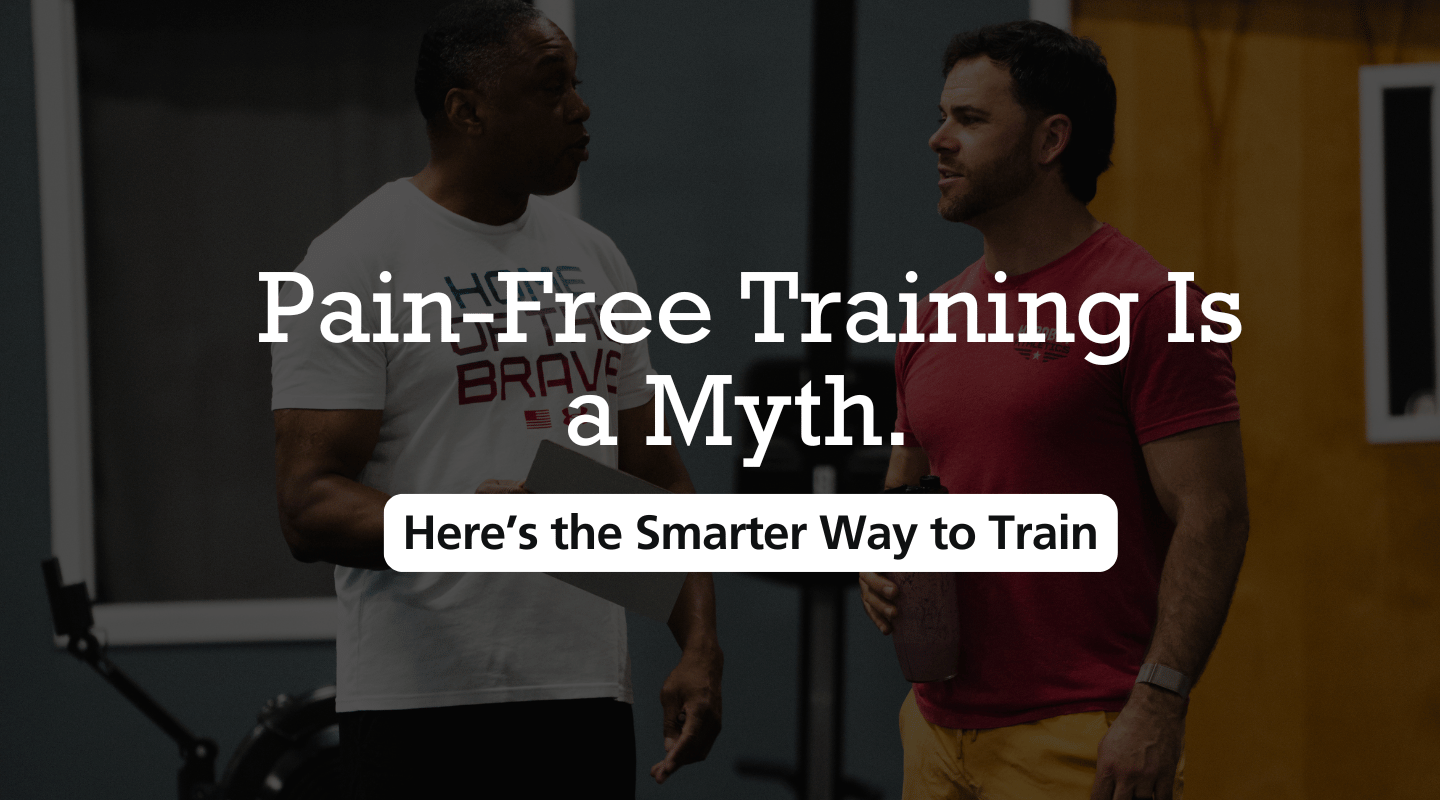
If you train long enough, something will hurt. At our strength & conditioning gym in Newark, DE, we teach members how to manage pain without panicking or quitting. Most flare-ups are load management issues, not broken bodies. Adjust volume first. Stay consistent. Get help when red flags show up.
And what not to do. That matters just as much.
Ben Franklin said nothing is certain in life except death and taxes.
I’d add a third. Something is going to hurt eventually.
If you’re training hard, living a full life, and asking your body to do real things, you will have days where your knee aches, your shoulder talks back, or you tweak something mid deadlift. That’s not a sign you’re broken. That’s a sign you’re doing something.
The question isn’t if it happens.
The question is whether you handle it well or make it worse than it needed to be.
The injury itself is often not the biggest obstacle. It’s the story you build around it.
When you stub your toe or get a paper cut, it can hurt badly. You don’t panic. You know why it hurts. You know it’s temporary.
But when something hurts during a workout and you don’t understand what’s happening, your brain goes into threat mode. You start wondering if you broke something permanent. You Google symptoms at 11pm. You find something scary. Now the pain feels like danger, even if it isn’t.
The pain isn’t always the problem. The story about what the pain means is where real damage happens.
Our culture overmedicates and overcomplicates normal aches that come with being active. That makes people feel fragile. Afraid to move. Convinced they need expensive fixes for what is often a simple load issue.
Structural findings on imaging often don’t match how someone feels. Many adults over 30 have disc degeneration and no pain. Many elite hockey players have torn hip labrums and play fine. Meniscus changes often show up on both knees, even if only one hurts.
Pain and damage are poorly correlated.
Organizations like the CDC and WHO both promote regular strength training because the long term benefits outweigh the risks for most people. Movement is protective, not harmful, when dosed well.
https://www.cdc.gov/physicalactivity
https://www.who.int
When you get a scary sounding diagnosis after a flare up, that finding likely wasn’t caused by what happened that day. You probably just exceeded what your body could handle.
That’s not a broken body. That’s load management.
Research on muscle strains shows that training within tolerable pain limits can improve strength without slowing healing. Pain is not always a stop sign. Sometimes it’s a speed limit.
Think about weight loss. Keto. Intermittent fasting. Vegan. Different methods. Same mechanism. Calorie deficit.
Training around pain works the same way. Whether someone tells you to fix your stabilizers or stretch your hip flexors, it works if it reduces stress on tissue that can’t tolerate current stress.
You can adjust:
Volume. The most powerful lever. Start here. Cut weekly sets for the irritated area by 50 percent. Hold that for two to three weeks before changing anything else.
Intensity. Lift lighter. Stay further from failure.
Range of motion. Stay out of the most loaded end ranges temporarily.
Exercise selection. Swap the aggravating movement. Train around the problem.
Tempo. Slower reps reduce force. Underrated tool.
Technique. Sometimes useful. Sometimes not worth chasing.
All of this means one thing. Less stress. For longer than you think you need.
If you train at a busy gym near me where programming is random, this gets hard. At Hardbat, we adjust on purpose inside our coached programs so you don’t have to guess.
Step 1. Cut volume by 50 percent for the affected area. Keep everything else the same. Run that for two to three weeks.
Step 2. If needed, reduce intensity. Back off load. Stay shy of failure. Slow the tempo.
Step 3. Swap exercises. If overhead pressing hurts, train delts and triceps in other ways. You’re rerouting, not regressing.
Step 4. Be patient. Most training aches improve over weeks to months. Not days. The biggest mistake is changing plans every three weeks and never letting anything work.
Make the smallest change that helps. Stick with it.
Corrective exercise can help. Stability drills. Mobility circuits. Activation work.
They work because they reduce load, slow you down, and make movement feel safe again.
That’s useful.
But if someone tells you your pain is caused by one tiny imbalance that must be fixed before you train normally, be skeptical. The evidence for those exact explanations is weaker than the confidence behind them.
What matters is that load is managed and you keep moving in tolerable ways.
Don’t let anyone convince you you’re fundamentally flawed. Most of the time, you did too much too soon.
Pain is not just physical.
High stress amplifies pain. Poor sleep amplifies pain. Under eating slows recovery. Low aerobic fitness reduces how well you tolerate training stress.
Groups like the American College of Sports Medicine consistently show that sleep, recovery, and proper progression matter as much as exercise selection.
https://www.acsm.org
Sometimes the best fix for a nagging knee is not a new quad drill. It’s eight hours of sleep and eating enough protein.
Don’t obsess over the one thing that hurts while ignoring everything else.
Get a professional involved if you notice:
Numbness or tingling down an arm or leg
Pain at rest or that wakes you at night
Symptoms worsening despite smart modifications
Acute trauma with severe pain or sudden loss of function
Find a PT who works with active adults and wants you back training, not sidelined forever.
When something flares up and forces you to pull back, it creates space.
Maybe you’ve ignored accessory work. Maybe you skipped mobility. Maybe your recovery habits slipped.
Pulling back from one thing lets you build others.
The goal isn’t to train in fear of pain. It’s to understand your body well enough to train for decades.
Something will hurt eventually. Now you know what to do.
At Hardbat Athletics, this is how we coach inside our strength programs in Newark, DE. We don’t shut people down at the first sign of discomfort. We don’t ignore red flags either. We manage load. We keep people moving. We build resilient adults.
If something is keeping you out of the gym, let’s fix that the right way.
Book a No Sweat Intro and sit down with a coach. We’ll look at your training, your schedule, and what’s bothering you, then build a plan that makes sense.


.png)






.png)
.png)










.png)


.png)


.png)


.png)


